VR in MBA Business Education
VR is redefining MBA education by turning case studies into immersive leadership simulations with measurable real world impact.
Author -Bhanvi Sharma
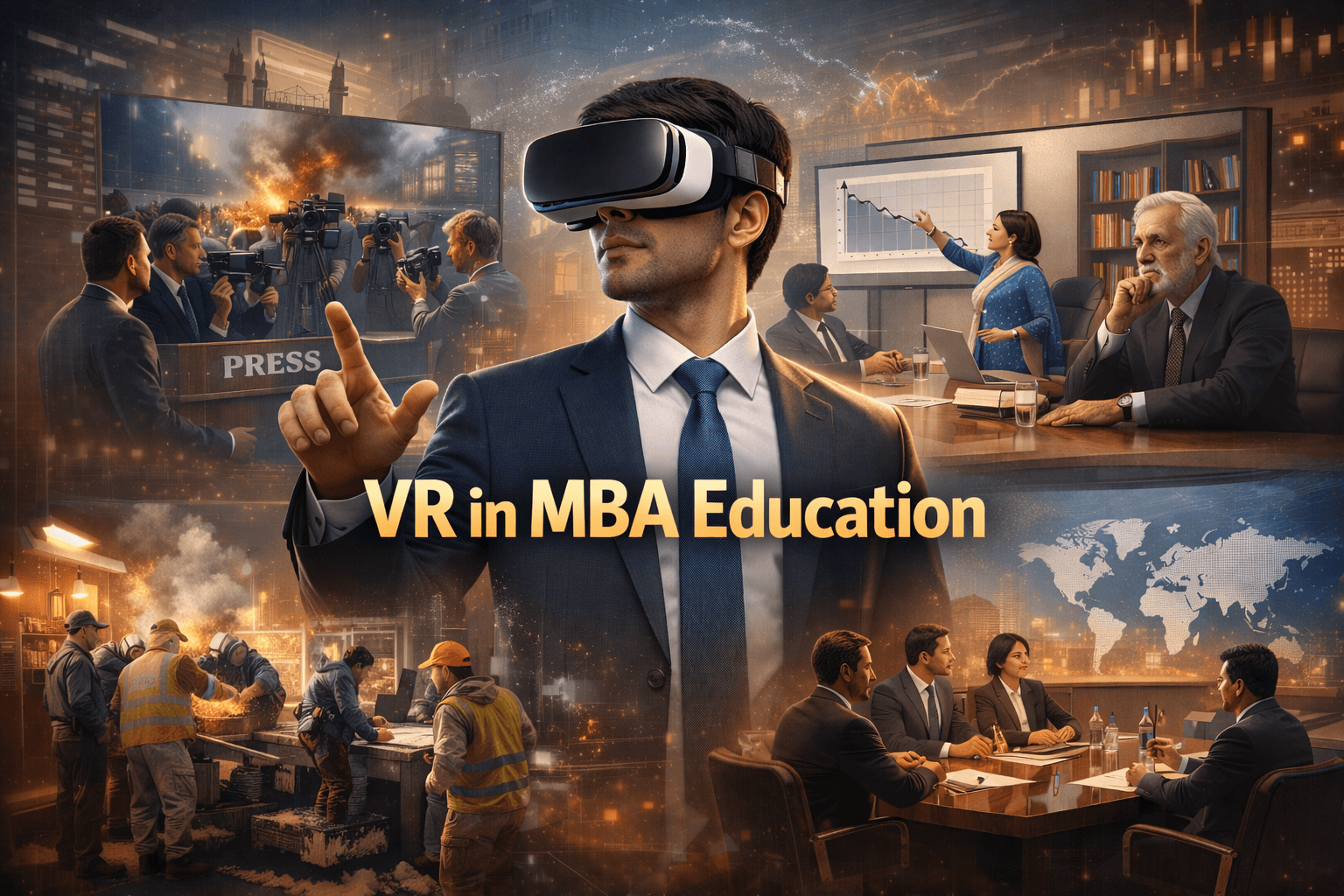
Virtual reality(VR) is no longer a flashy add on for forward thinking instructors. It's re-shaping how MBA students learn strategy, leadership and soft skills by turning abstract case studies into immersive and repeatable experiences. Below I explain what's changing, why it matters, where its already working, barriers schools face and concrete next steps for programs and students who want to try VR today.
What VR brings to business education
Immersion over description: the traditional case discussions rely on reading, role play or video.VR places learners inside the scene-a tense boardroom, a factory floor disaster or a multinational negotiation-so they physically experience timing, nonverbal cues and situational stress. This presence increases emotional engagement and recall, making lessons stick beyond test day.
Virtual Reality based casestudies –Strategic management never felt so real… Ithai Stern- INSEAD, Niron
Soft skills become measurable: The VR PLATFORMS track voice pattern,eye contact, response timing and decisions under pressure.That data lets instructors give precise feedback on negotiation tone, empathy in performance reviews or crisis communication. Corporate partners prize these measurable improvements when hiring MBAs for leadership roles.
Safe, repeatable failure: The ability to rewind or run multiple scenarios lets learners fail fast, reflect and iterate-a learning cycle that mirrors the best experiential programs, but at scale. This is especially important for high stake contexts(layoffs, PR crisis, ethical dilemmas)where real mistakes have real costs.
Exploring VR-EnhancedLearning in Business Education: A Multi-Site Study
Evidence it actually improves outcomes
Recent empirical work shows positive effects of VR on engagement, comprehension and empathy:
1. Controlled studies comparing written/ video/ case formats report higher engagement and better long-term recall for VR participants.
Transforming business education: the impact of virtualreality on learning outcomes in case studies
2. University research indicates VR can accelerate the development of empathetic communication and realistic managerial practice.
While effect sizes vary by study and scenario type, the convergence of multiple academic and field studies suggests VR is more than hype for experience learning-it's a validated tool when content and pedagogy are designed together.
Real implications and vendors to know
Many business schools and corporate training teams now partner with specialist XR vendors or build bespoke experiences:
1.Strivr: Enterprise XR platform used widely for workforce training and large scale deployments;strong in analytics and operational training. Strivr
2. VirtualSpeech: Focuses on soft skills and public speaking scenarios with partnership across universities. VirtualSpeech
3. Academic pilots: INSEAD, Stanford and several business schools have run VR leadership and case study pilots, reporting higher engagement and novel assignment opportunities. Making VR a Reality in Business Classrooms | Harvard Business Impact Education
Corporate case studies from Walmart, Accenture, KLM and healthcare institutions show VR's capacity to deliver consistent, measurable training across distributed workforce - a model many MBA programs emulate in executive education offerings. Walmart VR Training Metaverse Case Study
Design principles for effective VR based MBA learning
1. PEDAGOGY first, tech second: The scenario must map to learning objectives (example; ethical reasoning, supply chain triage), not simply showcase the headset Virtual Reality based case studies –Strategic management never felt so real… Ithai Stern- INSEAD, Niron Hashai
2. High Fidelity decision points: Give learners real trade offs with ambiguous outcomes rather than scripted " right answers". Reflection and instructor debriefs are essential. Exploring VR-Enhanced Learning in Business Education: A Multi-Site Study
3. Analytics+ human coaching: Use behavioural data to guide one on one coaching; numbers without conversation miss nuance. Strivr
4. Accessibility and variety: Offer non VR alternatives and mobile/ desktop derivatives so students with motion sensitivity or Limited hardware can still participate. Exploring VR-Enhanced Learning in Business Education: A Multi-Site Study
Barriers and how schools are overcoming them
Cost and Hardware Logistics: High quality VR hardware and bespoke content can be expensive.Many schools mitigate cost by starting with pilots, using shared Labs or partnering with vendors who provide device as a service. 4 Inspiring VR Case Studies to Help You Get Organizational Buy-In - ArborXR
Faculty readiness: Professors used to Socratic teaching may need training in debrief techniques for immersive scenarios.Successful programs invest in faculty workshops and co development with instructional designers. Making VR a Reality in Business Classrooms | Harvard Business Impact Education
Assessment alignment: Traditional exams don't capture what VR measures.Leading programs redesign rubrics to include behavioural criteria such as empathy, communication clarity and real time decision quality. Virtual Reality based case studies –Strategic management never felt so real… Ithai Stern- INSEAD, Niron Hashai
What students and programs can do next
1. For programs: Start with focused pilot(example, one core leadership module), collect both qualitative debriefs and quantitative metrics and iterate before a wider rollout. Partner with an established XR vendor rather than building everything in house unless you have long term scale needs.
2. For students: Seek VR enabled electives or executive workshops, practice soft skill modules on platforms like VirtualSpeech and request scenario based assessments where possible-these experiences stand out on CVs.
Conclusion
VR doesn't replace thoughtful case analysis-it augments it. By making learners feel the consequences of decisions, VR adds a layer of psychological realism that pure text or slides cannot match. When implemented with careful pedagogy, measurable analytics and strong debriefing,VR transforms MBA simulations from theoretical exercises into powerful labs for leadership.