Market Research – New Product Launch
Managing a virtual product launch through the Taxila Business Simulation reveals how real businesses respond to competition, shifting demand, and operational challenges while balancing growth with profitability.
Author -Bhanvi Sharma
Taxila Business Simulation provided an experiential opportunity for students to see how their strategic choices impact the performance of their organization in a competitive marketplace.
The simulation used a Product Launch format and was based in the Fast-Moving Consumer Goods (FMCG) sector. This simulation had students managing a virtual organization over multiple quarters, where they made decisions in real time about product development, price, distribution, and promotional activities.
In addition to creating profits, the simulation assessed the participants’ ability to be strategically consistent in the face of a changing market, remain responsive to the needs of the market and make long term plans for growth.
As the students completed 12 quarters of business, it became apparent that sustainable success is dependent upon the alignment of all business functions that affect organizational operations in response to changing market conditions.
Understanding the Marketing Mix Framework
The core of this simulation was the use of the Marketing Mix Framework, which includes four components: Product, Price, Place, and Promotion. Students were tasked with allocating resources towards product attributes, such as quality, taste, and packaging, that would have a direct effect on customer perceptions and ultimately position the brand in the market.
Students were also responsible for making decisions that required a careful balancing act between increasing revenue while potentially reducing the number of products sold, versus reducing prices and affecting the bottom line (profit).
Students were also responsible for developing and implementing a distribution strategy that would determine market reach via digital platforms, supermarket chains, and traditional retail channels. Students were also responsible for allocating marketing budget among several categories including digital advertising, influencer marketing, television, and outdoor media.
During the course of the simulation, there were continuous changes to the marketplace caused by factors outside student’s control, including increased demand during festivals; disruption to the supply chain, and competitors’ new product launches.
In many cases, these unforeseen changes to the market required students to alter their strategies in order to meet their long-term goals. Ultimately, the simulation demonstrated that business decision-making is highly interdependent - for example, a pricing decision can affect the level of demand elasticity, the efficiency of marketing, and profitability at the same time.
Strategic Adaptation and Performance Outcomes
During the simulation, I learned how critical strategic adaptability is. The first few quarters were spent balancing brand awareness, establishing product-market fit, and then selling the product so that I could focus my later efforts on optimizing profits and growing market share.
During the simulation, I learned that if I invested enough in marketing, then brand awareness, and consequently, sales performance would improve. I learned that brand awareness and market access investments would start to result in compounded advantages.
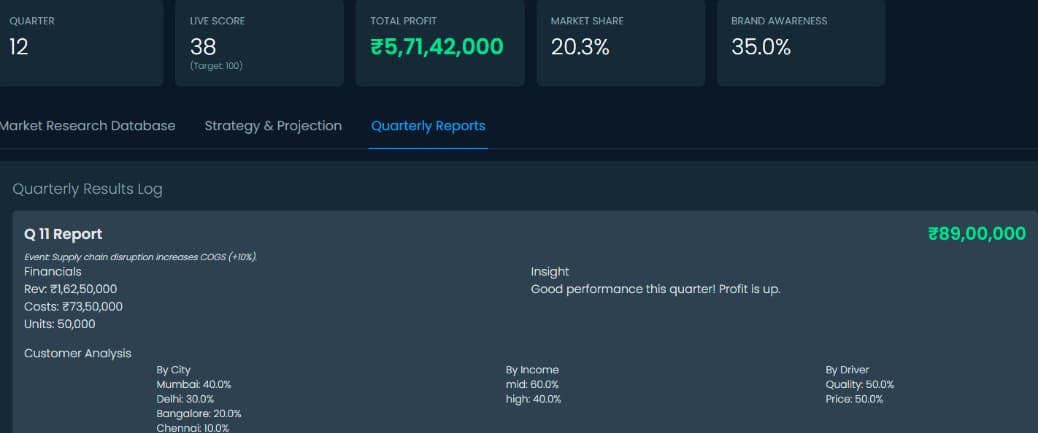
The metrics used to measure our performance included market share, brand awareness, and cumulative profit, and showed how effective our decision-making was on a quarter-by-quarter basis.
The simulation showed that when a team maintains strategic alignment, it leads to high earnings and positive financial results, as well as deeper market penetration and profitability. The most critical takeaway, however, was the insight into the interdependencies between operational efficiency, competitive stance, and consumer patterns, particularly within a shifting business ecosystem.
The exercise demonstrated to participants that thriving businesses successfully manage the interplay between immediate financial objectives and the broader goals of brand equity and market sustainability.
Key Business Lessons Learned
· Strategic choices must remain consistent over many periods in order to achieve sustainable results.
· A balance between competitive pricing and profit over premium positioning is more effective than premium positioning alone.
· Distribution growth is key to market penetration, which is a particular issue in diverse consumer markets.
· Marketing investments build brand awareness which in turn fuels long term demand growth.
· Market disruptions require adaptive leadership rather than reactive decision making.
· Data driven information greatly improves strategic planning and competitive position.
My Experience and Reflection
Participation in Taxila Business Simulation gave me a practical take on managerial decision making which goes beyond what is presented in the classroom. I had the chance to step into the shoes of business leaders and guide organizations through issues of uncertainty, competition, and issues of resource allocation.
Each quarter we had to do analysis, forecasting and strategic alignment which very much played out like real corporate decision-making settings. The simulation not only improved my understanding of marketing and operations strategy but also improved my perspective on integrated business planning and long-term value creation. As a whole the exercise was a practical bridge between academic theory and real-world business practice which made it a very impactful learning experience.