The Due Diligence Disaster- When Business Analysis Becomes a Strategy Game
Experience the Due Diligence Disaster business simulation and explore how financial analysis, strategic decision-making, and ethical judgment come together under real-time pressure in a high-stakes learning environment.
Author -Bhanvi Sharma
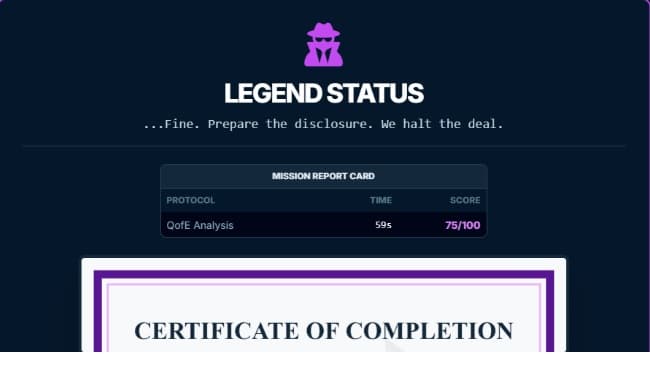
The Due Diligence Disaster simulation quickly went beyond classroom activity and transformed itself into a live investigation. The ticking clock for the hour-long scenario injected urgency and constant decision-making at the forefront.
Inaccurate decisions penalized participants by reducing available points. While moving through the problem areas, I found myself highly motivated to reach the next level. The progression seemed addictive, and each successful stage enabled increasingly detailed analysis and decision making. Instead of simply applying theoretical concepts, the simulation required participants to think and react like an analyst under pressure during an active acquisition target review.
Reconstructing Financial Reality and Operational Efficiency
The simulation opened with the QoE test, which showed that earnings, as reported, do not always reflect actual operational reality. This test required participants to normalize EBITDA by eliminating one-off accounting distortions and focusing on normalized operational performance—to highlight what investors look at in order to determine whether a deal is acceptable. The analysis of Free Cash Flow and Net Working Capital revealed similar insights regarding cash generation and liquidity.
Key learning outcomes included:
1. Normalizing earnings by separating recurring operations from financial statement noise.
2. Assessing the sustainability of cash flow instead of relying on the performance of the income statement.
3. Understanding how changes in working capital directly affect liquidity.
4. Using CPM principles to shorten project schedules with the minimal increases in cost.
In the operational “project crashing” phase it became evident that efficiency was not a measure of speed, but rather an optimal rate of acceleration. In choosing only critical-path activities and focusing on those with the lowest cost per day, it became clear that operational choices often include a balancing act between time, resources, and diminishing returns.
Once the simulation had progressed to strategic assessment, decision-making went beyond calculations. When applying Porter‘s Five Forces, the assessment of market structural attractiveness relied on interpreting competitive signals. Customer Lifetime Value analysis also revealed that a combination of retention, margin and churn provided an indication of sustainable growth prospects. The interwoven structure of the simulation led each decision to feel like a progression, with financial confirmation feeding back into operational judgment and ultimately shaping strategic conclusions. Together with the ticking clock, this created momentum that ensured engagement was maintained.
Analytics, Ethics, and Decision-Making Under Time Pressure
In the subsequent phases, analytical processes were combined with issues of ethical leadership. Forensic data auditing was applied to reporting, where illogical relationships between reported profits emerged, demonstrating how small numerical inconsistencies can be a red flag for governance weaknesses.
Key takeaways from the final stages included:
1. The identification of financial anomalies with the use of formal data validation techniques.
2. Understanding data integrity as an element of the trust in the organization
3. Utilize evidence to justify management decisions: How they will respond to the pressure through logic and reasoning and regulation, NOT confrontation.
The final round negotiation showed that while strong technical skills were crucial, they are useless without applying them with principles. At this point, the simulation had developed into something that accurately mirrors the experience of doing business, complete with lack of time, incomplete information and accountability. The 60-minute limit, which did not relax throughout the negotiation round, steadily increased the pressure and made the learning process an exciting and competitive one.
Thus, Due Diligence Disaster proved that business simulation could link theory with practice and that due diligence requires logical accuracy and analytical thinking combined with accountability.