Taxila vs Tepper: The AI Simulation Shift
A comparative look at AI powered MBA simulations at Tepper School of Business and Taxila Business School and their impact on management learning.
Author -Bhanvi Sharma
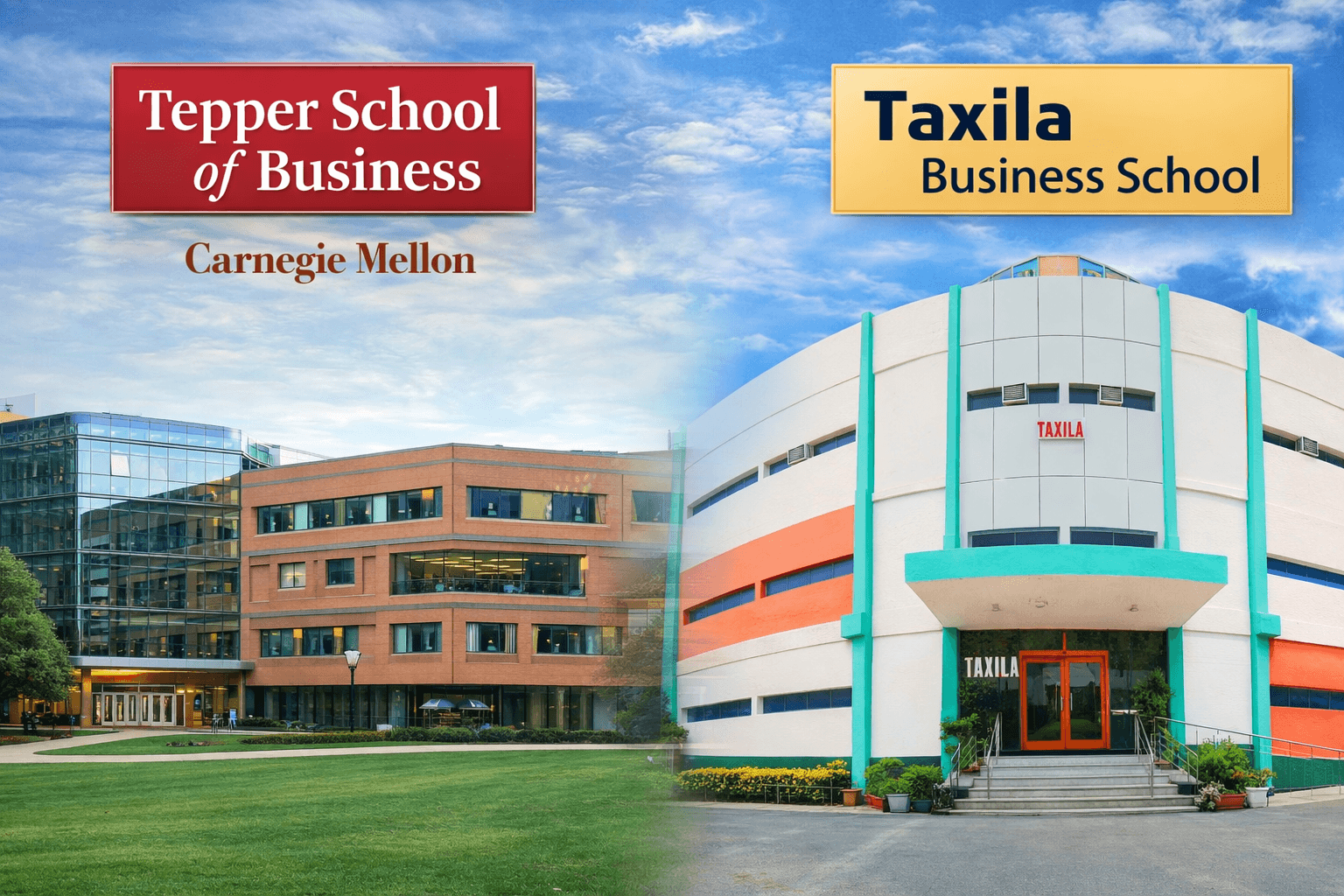
Business schools across the world are starting to question whether traditional ways of teaching management are still enough.!?
Instead of relying on the case studies and exams, leading institutions are now turning to simulations powered by artificial intelligence (AI) to help students practice the real decision making. Two schools that reflect this shift, despite being in very different geographies, are the Tepper School of Business at Carnegie Mellon University in Pittsburgh, United States and Taxila Business School in Jaipur, India. While their scale and the context differ, both are working toward the same goal: Preparing MBA students for real world leadership through simulation based learning.
Tepper School of Business (Pittsburgh, USA):AI Inside the Simulation Itself
At Carnegie Mellon University’s Tepper School of Business, The AI is being used as part of the learning environment, not just as the background support tool.
In 2024- 25, Tepper introduced AI powered Interactive learning labs as part of its broader Collaborative AI initiative. These labs are designed to simulate the real business situations where the students must make decisions under uncertainty, deal with competing stakeholder interests and understand the long term consequences.
Unlike the traditional simulation that follow fixed rules, Tepper's approach allows scenarios to shift in response to the student choices, and sometimes in unexpected ways.
The system can represent market reactions, stakeholder responses and the complex trade offs, making the experience closer to the real managerial work. The idea is simple but very powerful: Students should practice judgement in environments that behave like real businesses not spreadsheets.
Signature Initiative: Collaborative AI | Tepper School of Business
Poets&Quants | ‘We Want To Define The Future’: Inside CMU Tepper’s AI-Powered Transformation
Taxila Business School (Jaipur, India): Simulation at Scale with AI Feedback
In Jaipur, India, Taxila Business School is applying the same philosophy- learning by doing- but through a platform driven model. Taxila integrates simulations across its PGDM program using its Taxila Simulation and ERP Hub, where students manage business scenarios related to finance, marketing, operations and strategy.
What stands out here is not just the number of simulations, but how often the students are pushed to revisit and rethink all their decisions.
Taxila's emphasis on analytics dashboard and AI powered feedback available around the clock. Students can see how their decisions affect performance metrics and receive structured feedback that helps them improve in the next round. Instead of one time simulation exercises, these tools are used repeatedly across subjects, reinforcing learning through practice.
Taxila positions its simulations as the realistic management environments where students step into the decision maker roles and experience the pressure, trade offs and accountability of running a business.
https://simulation.taxila.in/blogs
Where Tepper and Taxila Are Aligned
Despite differences in geography, resources and program scale, Tepper and Taxila are aligned in important ways.
First, both prioritize simulations over passive learning. Students are not just discussing what managers should do - they are making decisions and living with the outcomes.
And sometimes, those outcomes are uncomfortable.
Second, both use AI to strengthen learning loops. At Tepper, AI helps shape complex scenarios and stakeholder behavior. At Taxila, AI supports feedback, analytics and performance tracking. In both cases, students move through a cycle of decision → outcome → reflection → improvement.
This kind of learning is harder to get comfortable with, especially at first.
Third, both are preparing students for work places where AI is present. Modern managers rarely make decisions without data systems or intelligent tools. These schools are training students to think clearly and responsibly in an environment where AI supports- but does not replace human judgment.
For students, this makes the learning feel a lot less theoretical and more personal.
The Key Difference: Depth vs Research
The main difference lies in how the AI is used.
At Tepper (Pittsburgh, USA), AI is deeply embedded into the simulation architecture itself, shaping how the environment reacts and evolves. This reflects Carnegie Mellon’s strong research background in AI and systems thinking.
At Taxila (Jaipur, India), The AI acts more as an accelerator of learning - enhancing simulations through continuous feedback, analytics and structured performance insights. The focus is on giving more students repeated exposure to decision making at scale.
On paper, the approaches look similar but in practice they serve slightly different teaching priorities.
Neither approach is " better" in isolation. They represent two valid ways of applying AI to simulations based on institutional context and goals.
Why This Comparison Matters
Together, Tepper and Taxila show where MBA education is headed globally. Whether in the United States or India, business schools are moving away from theory heavy instruction toward simulation first learning, supported by AI.
What’s interesting is how similar this shift looks even across very different education systems.
The message is clear: Future managers must practice making decisions before they are responsible for real companies. The AI powered simulations make that possible - by creating a safe but realistic environment where mistakes become lessons, not just failures.
As more schools follow this path, the simulations are likely to become a core pillar of MBA education, not just an add on. Tepper and Taxila from Pittsburgh to Jaipur are already proving that this shift is underway.